
Thick Film vs PCB — Which Is Right for Your Application?
There is a point in every hardware design where the question becomes unavoidable.
Standard PCB or thick film on ceramic?
For engineers who have only worked with FR4, the answer feels obvious. PCBs are familiar, fast to source, and cost-effective at volume. But for applications where the operating environment is extreme, the reliability requirement is absolute, or the form factor demands miniaturization beyond what organic substrates can support — that assumption deserves a serious second look.
Here is an honest, technical comparison to help you make the right call.
What You Are Actually Comparing
A printed circuit board is a laminated structure — copper traces etched onto a fiberglass-reinforced epoxy substrate. It is an excellent platform for the vast majority of electronics applications. It is fast to design, widely manufactured, and well understood.
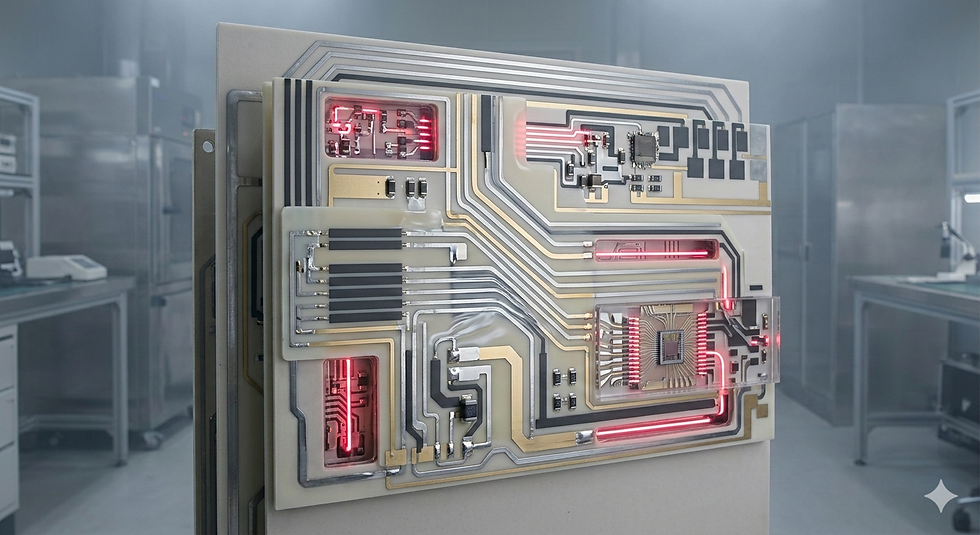
A thick film circuit is a fundamentally different construction. Functional materials — conductors, resistors, dielectrics — are screen-printed onto a ceramic substrate and fired at temperatures between 600°C and 900°C. The result is a circuit where the components are fused into the substrate itself rather than sitting on top of an organic carrier.
The difference matters enormously in certain conditions. In others it does not matter at all.
Temperature
This is where the comparison ends quickly for many applications.
FR4 has a glass transition temperature of approximately 130°C to 170°C depending on the grade. Above this point the substrate begins to soften and lose dimensional stability. Practical operating limits for most PCB assemblies are well below 125°C continuous.
Thick film circuits on alumina ceramic operate continuously at temperatures well above 200°C. On aluminum nitride or beryllium oxide substrates, reliable operation extends to 300°C and beyond. Specialized thick film designs have demonstrated stable performance at 500°C and higher.
For downhole oil and gas electronics, aerospace engine compartment sensors, industrial furnace controls, and space applications involving thermal cycling from -100°C to +200°C — FR4 is not a consideration. Thick film on ceramic is the only viable technology.
If your application operates below 125°C continuously with no extreme thermal cycling requirement — PCB handles this comfortably.
Thermal Management
Heat dissipation is where ceramic substrates separate themselves most clearly from organic materials.
FR4 has a thermal conductivity of approximately 0.3 W/m·K. Alumina sits at 20 to 28 W/m·K — roughly 80 times better. Aluminum nitride reaches 170 to 230 W/m·K — nearly 700 times better than FR4.
For power electronics, RF amplifiers, laser drivers, and any circuit where significant heat must be removed from a small area — FR4 simply cannot move heat fast enough. The component runs hot, thermal resistance builds up, and reliability degrades.
Thick film on ceramic moves heat away from active components efficiently, allowing higher power densities in smaller footprints without thermal runaway.
If your circuit dissipates more than 1 to 2 watts per square centimeter — ceramic substrate thermal management becomes a serious advantage.
Reliability and Longevity
PCBs absorb moisture. The epoxy matrix in FR4 is hygroscopic — it takes on water from the environment. This moisture affects dielectric properties, promotes electrochemical migration, and degrades solder joint reliability over time under thermal cycling.
Ceramic is inert. It does not absorb moisture. It does not outgas in vacuum. It does not soften under heat. It does not swell, warp, or delaminate over thermal cycles the way laminated organic materials do.
For applications requiring 20-year service life — implantable medical devices, aerospace avionics, space systems — this difference is not academic. It is the reason thick film on ceramic is specified for life-critical and long-life applications while FR4 serves applications with shorter service lives or less demanding environments.
Size and Density
Thick film circuits enable a level of component integration that discrete PCB assembly cannot match. Resistors, conductors, and dielectric layers are printed directly onto the substrate — eliminating the need for discrete resistor packages and the board area they consume.
Wire bonded die on thick film substrates eliminates IC packages entirely — bare die is bonded directly to the circuit. The result is circuits that are significantly smaller and lighter than equivalent PCB assemblies.
For aerospace and medical applications where every gram and every cubic millimeter of volume matters — this integration capability is a decisive advantage.
Cost
PCB wins on cost for standard applications. Full stop.
FR4 fabrication is a mature, globally distributed industry. Bare board costs are low. Assembly is fast and automated. For commercial electronics, consumer products, and industrial equipment operating in benign environments — PCB is the economical choice and the correct one.
Thick film manufacturing involves precious metal pastes, ceramic substrates, and high-temperature firing equipment. Per-unit costs are higher. The economics make sense when the performance requirement justifies it — not before.
Which Technology Is Right for Your Application
Choose PCB when:
Operating temperature stays below 125°C
Thermal dissipation is moderate
Service life is under 10 years
Environment is controlled — no extreme vibration, moisture exposure manageable
Cost is the primary constraint
Choose thick film on ceramic when:
Operating temperature exceeds 125°C or involves extreme cycling
High power density requires superior heat dissipation
Application demands 20-year or lifetime reliability
Operating environment includes vacuum, radiation, extreme vibration, or moisture
Miniaturization beyond PCB limits is required
Application is aerospace, defense, medical implantable, or space
These are not competing technologies fighting for the same market. They are complementary technologies serving different engineering requirements. The mistake is not choosing one over the other — the mistake is choosing the wrong one for your specific application.
If your application can live comfortably within the temperature, reliability, and environmental limits of FR4 — use a PCB. It will be faster, cheaper, and entirely adequate.
If your application pushes beyond those limits in any meaningful way — thick film on ceramic is not a premium option. It is the correct engineering choice.
CMS Circuits manufactures thick film circuits and hybrid microelectronics for aerospace, defense, medical, and space applications. ISO 9001 · AS9100 Rev D · ISO 13485 · ITAR Registered. Murrieta, California.
Not sure which technology fits your application? [ Talk to Our Engineering Team → ]


Comments